Practice Interview Questions
Draw a round of interview practice questions matched to your role and level, answer against the clock, rate yourself, and see exactly what a strong answer looks like — including the mistakes to avoid.
STAR hints
Rate your answer (1 = poor, 5 = excellent)
Sample answer — key points
Common mistakes to avoid
Session summary
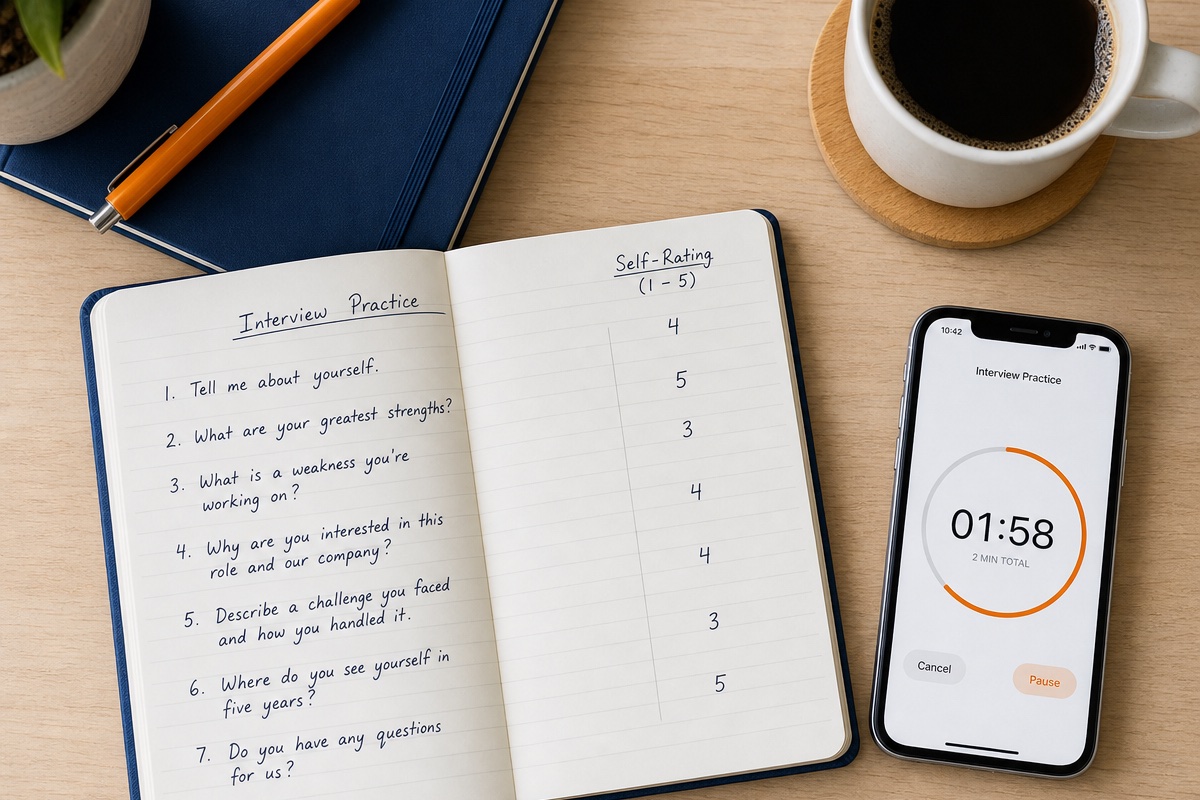
Why practicing with questions beats reading about them
Most interview preparation is passive: reading question lists, skimming sample answers, watching videos. It feels productive, but it trains recognition, not retrieval. In a real interview you must produce an answer under time pressure, out loud, from memory — a completely different cognitive task. Decades of learning research are unambiguous here: active recall and rehearsal under realistic conditions outperform review by a wide margin. That is why this tool is built around drawing questions, answering them against a timer, and rating your own performance rather than scrolling through lists.
The feedback loop is what makes practice compound. After each answer you rate yourself honestly from 1 to 5, then immediately see the model answer for that exact question — the key points it hits and the common mistakes candidates make. Maybe your answer missed a quantified result. Maybe you said "we" where you should have said "I." Seeing the gap right after speaking, while the attempt is fresh, is how each round makes the next one better.
How the question rounds work
Choose a target role — software engineering, product management, data, marketing, or general — a category (behavioral or situational), a difficulty, and how many questions you want. The tool first looks for questions matching all three filters exactly. If the exact pool is too small, it widens difficulty, then role, so a round always fills. That mirrors real interviews: you will not get to choose only questions in your comfort zone.
Behavioral questions ask what you have done — "Tell me about a time you failed" — and reward prepared STAR stories. Situational questions ask what you would do — "You discover a critical bug right before a release" — and reward structured thinking under ambiguity. Strong candidates practice both, because most interview loops mix them.
Getting the most out of each round
Treat every question as if an interviewer just asked it: pause for two seconds, then speak a full answer before you touch the rating buttons. Rate yourself honestly — a generous 5 teaches nothing. When the model answer appears, do not just read it; name the single biggest difference between its answer and yours. Write that difference down. Ten rounds of that habit will change how you interview more than any course.
When you are ready to go deeper on behavioral questions, build full answers with the behavioral interview prep STAR builder, or browse the complete question bank to target specific weaknesses.
Frequently asked questions
How many interview practice questions should I do per day?
One focused round of five questions beats an unfocused hour. Consistency matters more than volume — a daily five-question round for two weeks builds more durable skill than a weekend cram session.
Should I practice out loud or in my head?
Out loud, always. Answers that feel clear in your head often collapse when spoken. The two-minute timer exists because a real spoken answer runs 90–120 seconds; practicing silently trains the wrong skill.
What is the difference between practice mode and mock interview mode?
Practice mode shows STAR hints and lets you skip questions — use it while building your story library. Mock interview mode hides hints, auto-advances when the timer ends, and saves all self-rating for the end — use it to simulate real pressure.
Is my progress tracked or uploaded?
Your session history is stored only in your browser's localStorage. Nothing you say, type, or rate is uploaded to any server.
Sharpen your behavioral answers
Take the questions you rated lowest and rebuild them step by step with the STAR method.
Open behavioral interview prep